

This page presents Timeback’s product rationale and goals. Educational efficacy, market-wide comparisons, distribution commitments, and current program availability require evidence beyond repository code. Use the integration guides for implemented API behavior.
TL;DR: What Timeback is building toward
TL;DR: What Timeback is building toward
| Vision pillar | What it enables |
|---|---|
| Academics are efficient | Master academics faster, reclaim hours daily |
| A billion kids | Global scale through AI and falling costs |
| Proven in production | Evaluate outcomes for your own app |
| Build once, reach many | Reach schools, families, and global markets |
| Outcomes as product | Measured, verifiable, continuously improved |
| Standards backbone | Stop rebuilding the same infra from scratch |
| Learning science | Effective practices become platform defaults |
| Motivation + rigor | High standards that are engaging and hard to game |
Give kids their time back
The core promise: academics get radically more efficient. Students who learn faster reclaim meaningful time every day. That reclaimed time is the point. Space for sports, life skills, projects, creativity, and the rest of childhood. Time back is earned through real mastery. Students finish academics by demonstrating competence, then own their afternoon. The goal is a world where time-based schooling feels as outdated as time-based billing for compute.Scale to a billion kids
The long-term ambition is global scale. That requires a cost curve falling with software and AI progress. Once the closed loop exists, the system can improve instruction efficiently, localize content, and expand access without reinventing everything for each geography. AI is the lever. The platform uses AI to generate and personalize content, adapt pacing, close feedback loops, and reduce the marginal cost of instruction. As costs drop, access expands. The target: more learning per hour for more students, and more life reclaimed because academics stop consuming the whole day.Alpha School: the model in production
Alpha School is the working implementation. Students complete academics in two hours, then spend the rest of the day on sports, life skills workshops, passion projects, and character development. Results are measured continuously against external standardized tests.
The intended operating model is:
For developers, Alpha School provides credibility. An app must establish its own learning outcomes; using the same platform does not transfer evidence of efficacy. The same platform, the same learning engine, the same closed loop that powers Alpha School also powers your app.
Build once, reach many contexts
Timeback is a platform. The same infrastructure powers multiple deployment contexts:
Developers build once. Apps reach students across all contexts through a single integration. As Timeback grows, distribution grows with it.
Learning outcomes as the unit of progress
Education has plenty of metrics, but few hold up under scrutiny. Timeback’s default unit is an outcome: a demonstrated skill that transfers, persists, and shows up on meaningful assessments. The platform answers three questions continuously:
Instead of debating efficacy, the system measures it, compares approaches, and iterates. Apps improve over time because the feedback signal is shared and outcome-linked.
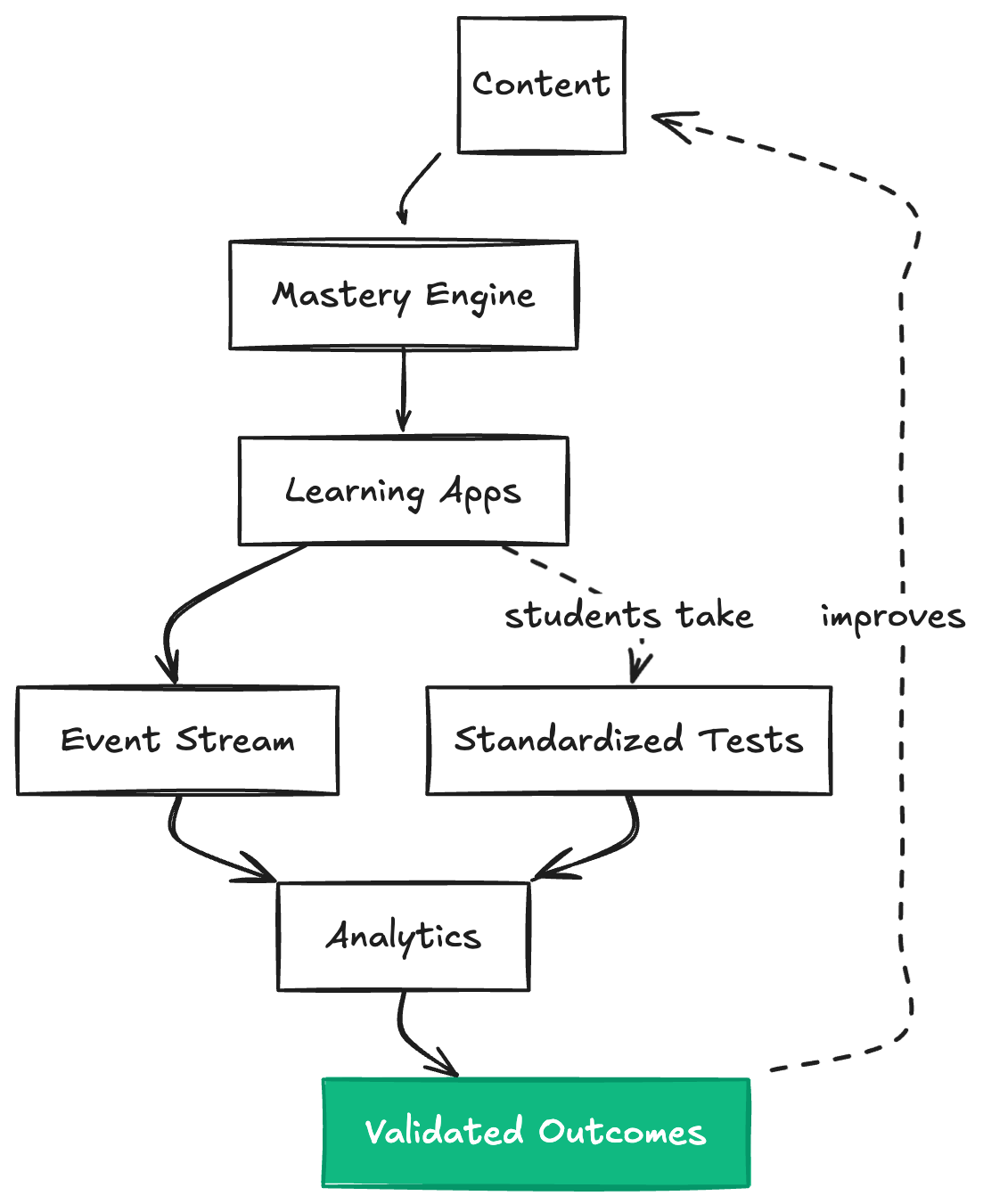
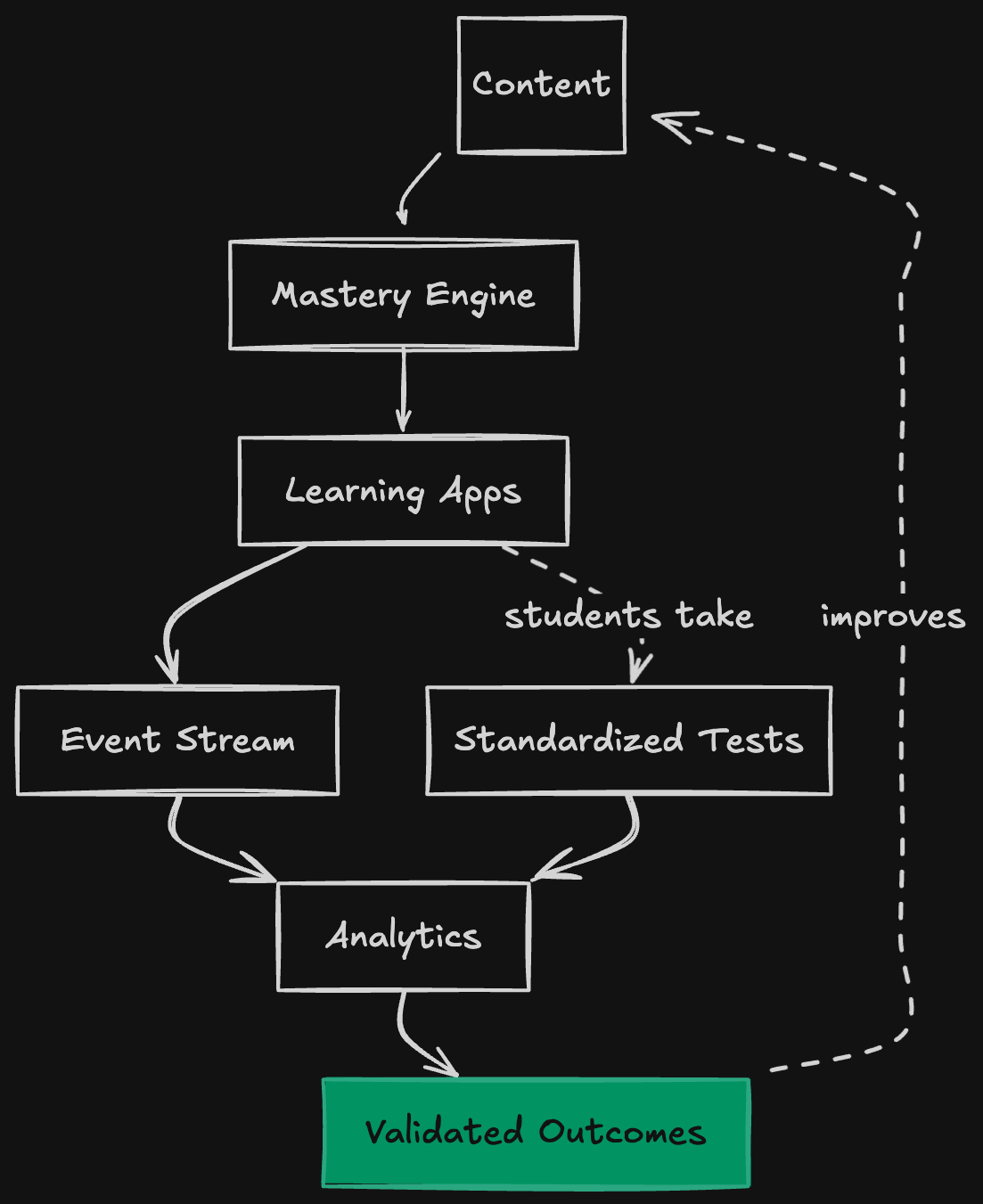
A shared, standards-based record
Timeback aims to become the shared system of record for the objects education software constantly re-creates: students, rosters, courses, content, results, credentials, and events. With a shared record, apps can specialize:- A tutoring app relies on the same student context as an assessment app
- A content tool emits results that a reporting tool can interpret
- Builders stop paying the “rebuild the platform” tax for every new product
Learning science as product constraints
Learning science should show up as constraints and defaults in software, not just in research papers or training decks:
When apps align on how mastery is defined and how progress is recorded, tools compound rather than conflict. Builders innovate on experiences and content while still participating in a common outcomes loop.
Motivation without lowering standards
A platform demanding real mastery must also make sustained effort emotionally worth it. Timeback treats motivation as a first-class system problem, with mechanisms that reward behaviors driving learning and guardrails that reduce gaming. Time back is the primary motivator: finish academics efficiently, earn your afternoon. Beyond that:- XP as a universal progress currency
- Rewards tied to mastery, not just completion
- Leaderboards engineered to create wins
- Visible proof that effort leads to results
Integrity and verifiability as defaults
If outcomes matter, integrity matters. Timeback is building toward a world where apps can prove what happened during learning. The goal: make measurement trustworthy and improvement possible. For developers, this means building in an environment where:- Effective work is measurable
- Anomalies are detectable
- Outcomes can be trusted across tools
This page describes where Timeback is headed. For the mechanics and interfaces, continue to the
architecture and principles pages.
The Problem
Why current edtech can’t reliably produce or prove outcomes.
How It Works
The platform components that enable the closed loop.
Principles
The constraints and defaults Timeback optimizes for.
Why Build Here
What developers get by building on the platform.